
Quick Answer
In 2026, Victoria, BC business owners typically find a web designer through four main channels: a Google search combined with the Google Business Profile map pack, referrals from other local business owners, directories like the Greater Victoria Chamber of Commerce and BBB serving Vancouver Island, and agency websites such as Maples Digital or one of the many freelance marketplaces. Which one is right for you depends less on where you look and more on your budget, timeline, and how much support you want after launch, which this guide breaks down in detail below.
If you have typed “web designer Victoria BC” into Google, you already know the problem isn’t finding results. It’s the opposite. You get freelancers on Upwork, boutique studios in Fort Street office buildings, national agencies with a Victoria landing page bolted onto their site, and DIY platforms all competing for the same search term. Some of these results are excellent. Some are a template with a Victoria zip code stapled on. There’s no obvious way to tell the difference from a search results page alone.
This guide is meant to close that gap. It covers where people in Victoria and across Vancouver Island actually source their web designers, what a website should realistically cost in 2026, the specific questions that expose a weak proposal, and the technical standards a website needs to meet this year to actually perform, not just look finished.
Where Do Victoria Businesses Actually Find a Web Designer in 2026?
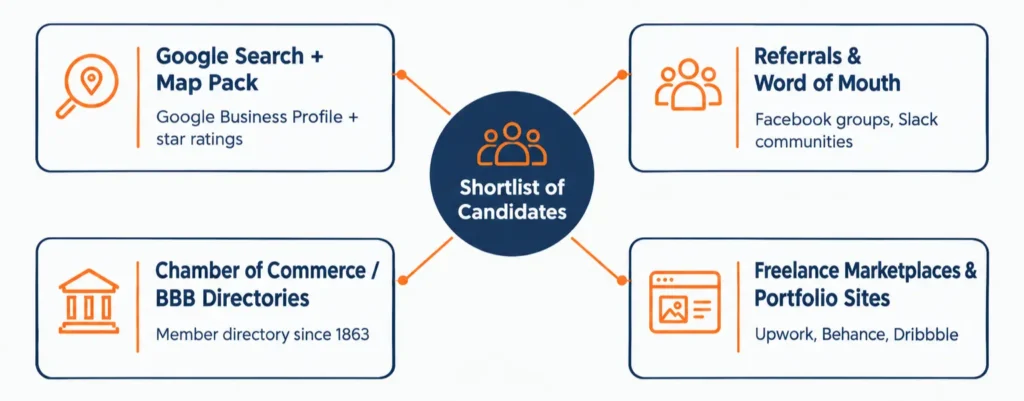
There isn’t one correct place to look. Most business owners end up combining two or three of the following.
Google search plus the local map pack. Searching “web designer Victoria BC” or “website designer near me” pulls up both organic results and, often, a map pack of businesses with Google Business Profiles tied to a Victoria address. This is usually the fastest way to see who is active and locally based, and it lets you check star ratings and review count before you ever contact anyone.
Word of mouth and referrals. Ask another business owner who redesigned their site recently, or drop the question into a local Facebook group or Slack community for Vancouver Island entrepreneurs. A referral from someone who has actually paid the invoice and lived with the website for a year is worth more than any portfolio page, because it tells you how the relationship holds up after launch, not just how the launch looked.
The Greater Victoria Chamber of Commerce. The Greater Victoria Chamber of Commerce has represented businesses across the region since 1863 and maintains a member directory that includes web design and marketing firms. Chamber membership isn’t a guarantee of quality, but it does mean a business has a registered, ongoing presence in the community, which is a reasonable first filter.
BBB serving Vancouver Island. The Better Business Bureau serving Vancouver Island lists businesses by category, including web design, along with any accreditation status and complaint history. It’s a useful second opinion once you already have a shortlist, particularly for checking whether a company has an unresolved pattern of client complaints.
Freelance marketplaces. Platforms like Upwork list independent web designers based in Victoria, often with portfolios, hourly rates, and client review history attached. This is a reasonable route for a narrowly scoped project, though quality and reliability vary widely and there’s typically no local point of contact if something goes wrong after the contract ends.
Portfolio and design platforms. Sites like Behance and Dribbble let you browse visual work by location or specialty, which is useful if aesthetics matter more to you than process at this stage of your search.
Local networking. Victoria has an active small business and startup scene, and web designers show up at industry meetups, chamber events, and small business workshops throughout the year. If you’re not in a rush, this is often how the strongest word-of-mouth relationships start.
None of these channels is inherently better than the others. What actually matters is what you do once you have a shortlist, which is covered further down.
The Main Types of Web Designers You'll Find in Victoria, BC
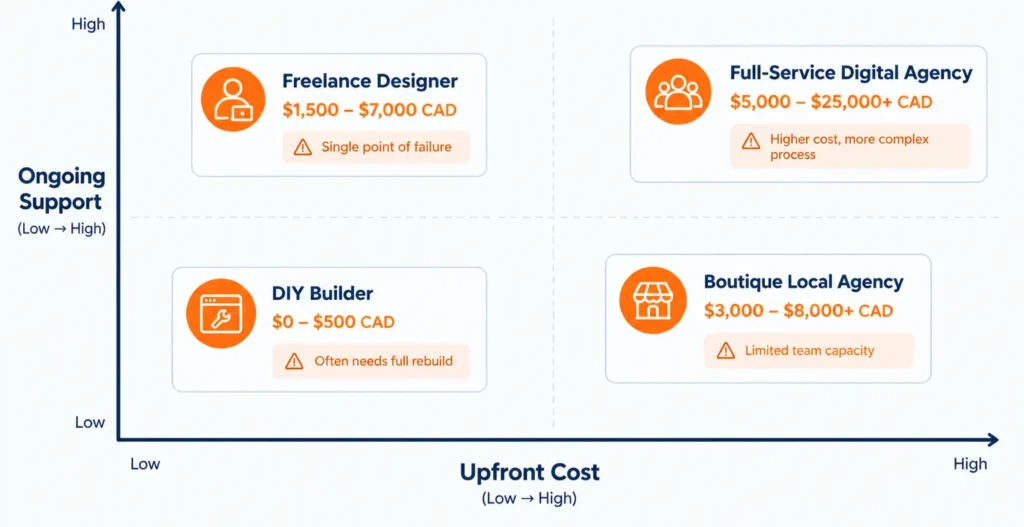
Almost every option that turns up in a search for web designers in Victoria BC falls into one of four categories. Each has a real trade-off, not just a price difference.
| Provider type | Typical cost (CAD) | Best suited for | Main risk |
|---|---|---|---|
| DIY builder(Wix, Squarespace, WordPress.com) | $0–$500 upfront, plus $300–$1,200/year in hosting and plugins | A very simple site you're willing to build yourself | Limited design flexibility; often needs a full rebuild once the business grows |
| Freelance web designer | $1,500–$7,000 one-time | Small, well-defined projects with a clear scope | Quality and availability vary; usually a single point of failure if they get busy or move on |
| Boutique local agency | $3,000–$8,000+ for a small business site | Businesses that want a custom design plus some strategic input | Team size can be small, so timelines can shift |
| Full-service digital agency | $5,000–$25,000+, higher for e-commerce or multi-location builds | Businesses that also want SEO, content, or ongoing marketing under one roof | Higher upfront cost; make sure "full-service" doesn't mean generic |
These ranges reflect what multiple Canadian web design pricing guides published in 2026 report as typical small-business project costs, and they roughly match the broader market data that industry sources like Clutch publish each year for web design agency pricing generally. Treat them as a planning benchmark, not a quote. Your actual number depends heavily on page count, whether you need e-commerce or booking functionality, and how much content still needs to be written.
How Much Does a Website Cost in Victoria, BC in 2026?
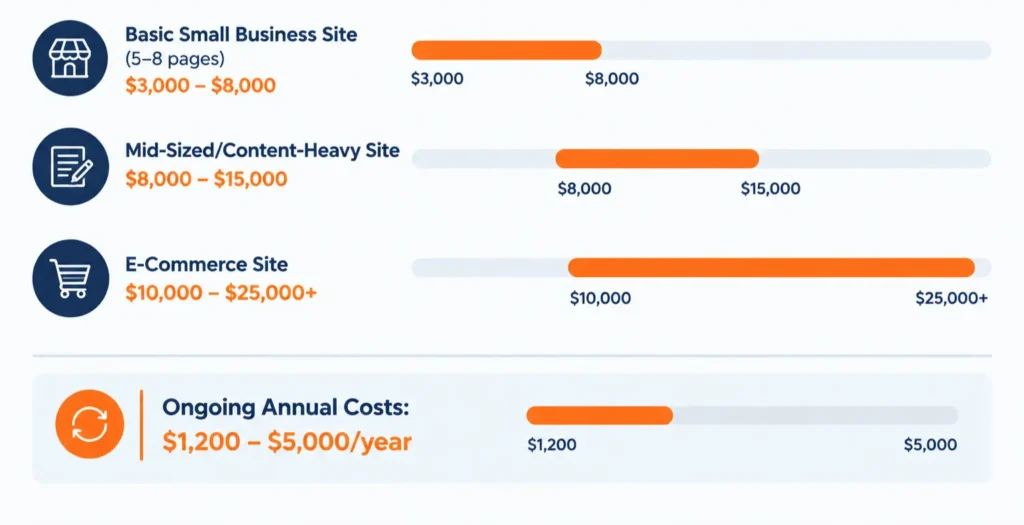
This is usually the first question people actually want answered, so here is the honest breakdown.
A basic small business site (roughly 5 to 8 pages, no e-commerce) generally lands between $3,000 and $8,000 CAD when built by a freelancer or boutique agency. This typically includes a homepage, an about page, a services or products section, and a contact page with a working form.
A mid-sized or content-heavy site, such as one with a blog, multiple service areas, or booking integration, tends to run $8,000 to $15,000.
An e-commerce site with product listings, checkout, and inventory management usually starts around $10,000 and can climb well past $25,000 depending on catalogue size and payment integrations.
Ongoing costs are the part most first-time buyers underestimate. Hosting, security updates, plugin maintenance, and content changes typically add $1,200 to $5,000 per year on top of the initial build, according to 2026 Canadian pricing guides. This is exactly the cost structure worth asking about before you sign anything, since it’s where a lot of “affordable” websites quietly become expensive over a two or three year period.
How to Vet a Web Designer Before You Sign Anything
A polished portfolio tells you almost nothing about how a project will actually go. These are the checks that do.
Look at the portfolio on your own phone, not just on their laptop demo. A site that looks sharp on a widescreen monitor can be slow or broken on mobile, and mobile now accounts for roughly six in ten website visits worldwide according to browser data tracked by StatCounter and reported via Statista. If a designer’s own showcase sites load slowly or look cramped on your phone, that’s a preview of what your own site will look like.
Confirm the business is actually registered. Anyone can put up a website claiming to be a Victoria company. British Columbia’s OrgBook BC lets you search a business name for free and confirm whether it’s a registered legal entity in the province, which takes about thirty seconds and is a step almost nobody actually does.
Ask what happens after launch, specifically. This is the single most revealing question you can ask. Get a plain answer to: what happens the first time I need a new page, a copy change, or a plugin update six months from now? Some companies quote a low build price and then bill separately for every future request. Others bundle a maintenance retainer you’re locked into whether you use it or not. Get this in writing before you compare prices, because two quotes that look similar upfront can end up thousands of dollars apart over three years once maintenance is factored in.
Ask whether SEO fundamentals are built in or sold separately. A properly built site should ship with clean heading structure, compressed images, basic schema markup, and reasonable load times from day one. If a designer treats these as a paid add-on rather than a baseline standard, that’s worth knowing before you sign.
Check reviews in more than one place. Google Business Profile reviews, BBB complaint history, and even a quick LinkedIn search for the company give you three different angles on the same business. A company with strong Google reviews but an unresolved BBB complaint pattern deserves a direct question, not automatic disqualification.
Get the ownership terms in writing. Confirm you own the final files, the domain, and the content once the project is paid for, and understand what happens if you want to leave the platform or switch providers later.
If you’re evaluating a marketing partner for both your website and your search visibility, our companion piece on 10 questions to ask before hiring an SEO agency in Victoria, BC covers several vetting questions that apply just as directly to a combined web design and SEO engagement.
What Every Victoria Business Website Needs in 2026
Design trends come and go, but a handful of technical standards now directly affect whether Google and AI-powered search tools will even show your site to potential customers.
Responsive, mobile-first design. This is no longer optional. A site needs to render cleanly across phones, tablets, and desktops, since the majority of visits will come from a phone regardless of your industry.
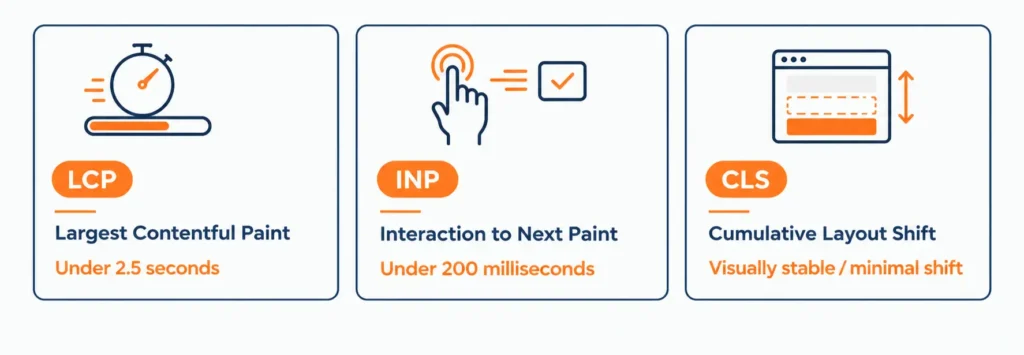
Core Web Vitals performance. Google measures three real-world metrics as part of its page experience signals: Largest Contentful Paint (how fast the main content appears, ideally under 2.5 seconds), Interaction to Next Paint (how quickly the page responds to a tap or click, ideally under 200 milliseconds), and Cumulative Layout Shift (how much the layout jumps around while loading). Google’s own Web Vitals documentation explains each metric in detail, and a slow or jumpy site can quietly cost you both rankings and customers who give up before it finishes loading.
Accessibility. The Web Content Accessibility Guidelines (WCAG) 2.2, published by the W3C, is now the international benchmark for accessible web design, covering things like sufficient colour contrast, keyboard navigation, and proper labelling for screen readers. Beyond being the right thing to build toward, an accessible site reaches a wider customer base and holds up better against legal risk as accessibility requirements tighten globally.
On-page SEO and structured data. Clean heading hierarchy, descriptive page titles, image alt text, and schema markup (structured data that helps search engines and AI answer tools understand what your page is actually about) all affect whether your business shows up not just in traditional search results but in AI-generated answer summaries as well.
Privacy and security basics. An SSL certificate is table stakes at this point, but Canadian businesses collecting any customer information through a contact form should also have a privacy policy that reflects Canada’s federal privacy law, PIPEDA. This is a detail a lot of template-based sites skip entirely.
A genuine conversion path. Whether the goal is a phone call, a quote request, or an online purchase, every page should make it obvious what to do next. A beautiful site that buries its contact form three clicks deep is a design failure, not a design win.
Does It Matter If Your Web Designer Is Actually Local to Victoria?
Partly. A designer based in Victoria or elsewhere on Vancouver Island generally has a better instinct for how local customers search and browse, whether that’s understanding seasonal tourism patterns, the mix of downtown foot traffic versus Saanich Peninsula commuters, or how a Vancouver Island service business’s customer base differs from a mainland one. That local familiarity can genuinely shape smarter decisions around navigation, service area pages, and local SEO structure.
That said, plenty of excellent web design work for Victoria businesses is done by people who have never set foot on the Island. If a remote designer takes the time to actually research your specific market rather than dropping your content into a generic template, location matters far less than the quality of that research. The honest answer is that “local” is a genuine advantage, not a hard requirement, and it should be one factor in your decision rather than the only one.
Where Maples Digital Fits Into the Picture
Since you’re reading this on our site, it’s worth being direct about where Maples Digital fits into everything above rather than pretending otherwise.
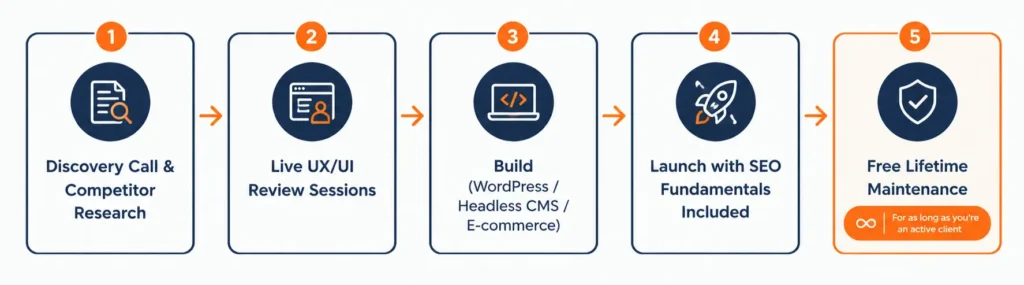
We’re a Victoria-based digital agency, and our Website Design & Development service was built around one structural difference from the standard model described earlier in this guide: instead of a build price followed by recurring maintenance invoices, we charge a single upfront project fee that also covers free lifetime maintenance, ongoing security and plugin updates, and new page additions for as long as you’re an active client with us. There’s no separate maintenance retainer to negotiate later, and no separate support desk to get handed off to if something breaks.
Every site we build also starts with a real discovery call and competitor research specific to your corner of Victoria or Vancouver Island, moves through live UX and UI review sessions rather than long email chains, and ships with responsive design, clean semantic code, and SEO fundamentals like schema markup and image compression included from the first line of code rather than sold as an add-on afterward. We work across WordPress, headless CMS builds, and e-commerce platforms depending on what a project actually needs, and the same team that designs your site is the one that maintains it afterward.
If any of that sounds like what you were hoping to find while researching a web designer in Victoria, BC, you can see the full process and a detailed FAQ on our Website Design & Development page, or read more about our approach on our About page.
Final Thoughts
Finding a web designer in Victoria, BC isn’t difficult. Finding one whose pricing model, process, and post-launch support actually match what they promised on the sales call is the harder part, and it’s almost always sorted out by asking direct questions before you sign rather than hoping for the best afterward.
If you’d rather skip the guesswork, Maples Digital offers a free strategy call to walk through your project scope and give you a straight, itemized proposal with no surprise maintenance bill waiting on the other side of launch. You can book a call here or explore more of our guides on website performance and local SEO while you weigh your options.
Frequently Asked Questions
Start with a Google search paired with the local map pack to see who’s active and locally based, then cross-check candidates against the Greater Victoria Chamber of Commerce directory and BBB serving Vancouver Island for accreditation and complaint history. Referrals from other business owners who have actually gone through the process are typically the most reliable single source.
A web designer typically focuses on layout, visual branding, and user experience, while a web developer handles the technical build, including code, functionality, and integrations. Many Victoria-based providers, including full-service agencies, offer both under one roof, but it’s worth confirming which side of the work a freelancer specializes in before hiring.
Based on 2026 Canadian pricing guides, a basic small business site with five to eight pages typically costs between $3,000 and $8,000 CAD when built by a freelancer or agency, not including hosting and future maintenance, which usually adds $1,200 to $5,000 per year.
Most small business websites take a few weeks to two months from kickoff to launch, depending on how quickly content and feedback are provided. E-commerce or highly custom builds usually run longer.
A freelancer often makes sense for a tightly scoped, simple project on a smaller budget, while an agency is generally better suited to a business that also wants ongoing SEO, content, or marketing support, or that needs the reliability of a full team rather than a single person.
Location isn’t a hard requirement, but a designer familiar with Vancouver Island’s business landscape often builds smarter local SEO structure and customer journey decisions from the start. Remote designers can absolutely do excellent work if they take the time to research your specific market.
At minimum: what happens to pricing after launch, who owns the final files and domain, whether SEO basics are included or extra, and what the actual timeline and revision process looks like. Getting straight answers to these four questions eliminates most of the risk in hiring a web designer.