
Quick Answer
Before hiring an SEO agency in Victoria, BC, ask to see a real website audit, how they’ll approach keyword research for a market this size, what their on-page and technical SEO process covers, how they’ll manage your Google Business Profile and local pack rankings, how they build backlinks, who writes the content, how they’re adapting to AI Overviews, how they report on organic traffic, what’s actually included in the price, and what happens if you don’t see results. An agency that answers all ten clearly, with specifics instead of buzzwords, is worth a second meeting. One that dodges two or three of them isn’t.
Hiring an SEO company is a strange kind of purchase. You’re paying monthly, often for six months or more, before you know if it’s working. You can’t test-drive it. You can’t return it if it’s bad. And by the time you find out an agency was coasting on vague reports and recycled tactics, you’ve usually lost half a year of visibility — and the competitor two blocks away has taken the customers you should have had.
That risk is higher in a market like Victoria. This isn’t Toronto or Vancouver, where there are enough searches and enough agencies that a mediocre one just blends into the noise. Victoria is smaller, tighter-knit, and the businesses competing for the same handful of high-intent local searches often know each other. A generic, copy-paste strategy built for a bigger city rarely translates, and a business owner without an SEO background has no easy way to tell a genuinely capable SEO agency in Victoria, BC from one that’s simply good at sales calls.
This guide is built to close that gap. Below are ten questions — the ones worth actually asking out loud in a discovery call, not just skimming — along with what a strong answer sounds like, what a red flag sounds like, and where Victoria’s market changes the calculus. There’s also a free checklist near the end you can bring into your own vetting calls, and a section addressing something most 2026 guides still gloss over: how a serious SEO company in Victoria, BC should be handling AI Overviews and AI-powered search, not just the traditional blue links.
Why Victoria, BC Is a Different Kind of SEO Market
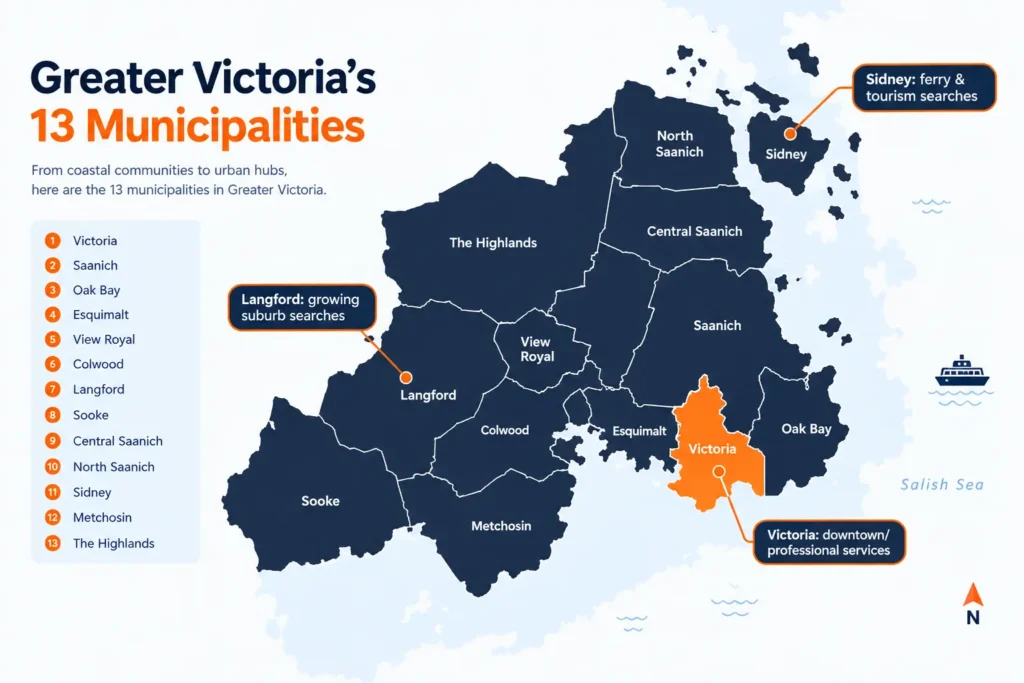
Greater Victoria isn’t one city — it’s a cluster of 13 municipalities (Victoria, Saanich, Oak Bay, Esquimalt, View Royal, Colwood, Langford, Sooke, Central Saanich, North Saanich, Sidney, Metchosin, and the Highlands), each with its own search behaviour and often its own community Facebook group where local businesses get recommended or warned about. A victoria bc seo strategy that only targets “Victoria” as a keyword misses a huge share of the actual searches happening across Vancouver Island — from Langford’s rapidly growing suburbs to Sidney’s ferry-and-tourism economy.
A few things make this region genuinely different from a typical mid-size Canadian market:
- It's the seat of provincial government and home to the University of Victoria, which means a chunk of the local economy — and local search volume — is tied to public sector, education, and professional services rather than pure retail.
- Roughly six in ten Greater Victoria Chamber of Commerce members run businesses with five employees or fewer. This is a small-business city. Local business marketing here has to work on a small-business budget, not an enterprise one.
- Tourism swings local search demand hard by season. A restaurant, tour operator, or hotel in downtown Victoria might live or die by summer "near me" searches from visitors, while the same local pack ranking matters far less to them in February.
- The tech sector — sometimes nicknamed "Tectoria" locally — has grown enough that SaaS and professional-services SEO now competes for attention alongside trades, healthcare, and hospitality.
None of this means Victoria businesses need something exotic. It means the agency you hire needs to actually understand the difference between optimizing for “plumber Victoria BC” and optimizing for “plumber near me” typed by someone standing in Langford — and needs a search engine optimization agency near me approach that’s genuinely local, not a Vancouver or Calgary playbook with the city name swapped out.
With that context, here are the ten questions worth asking.
1. Can I See a Full SEO Audit of My Website Before I Sign Anything?
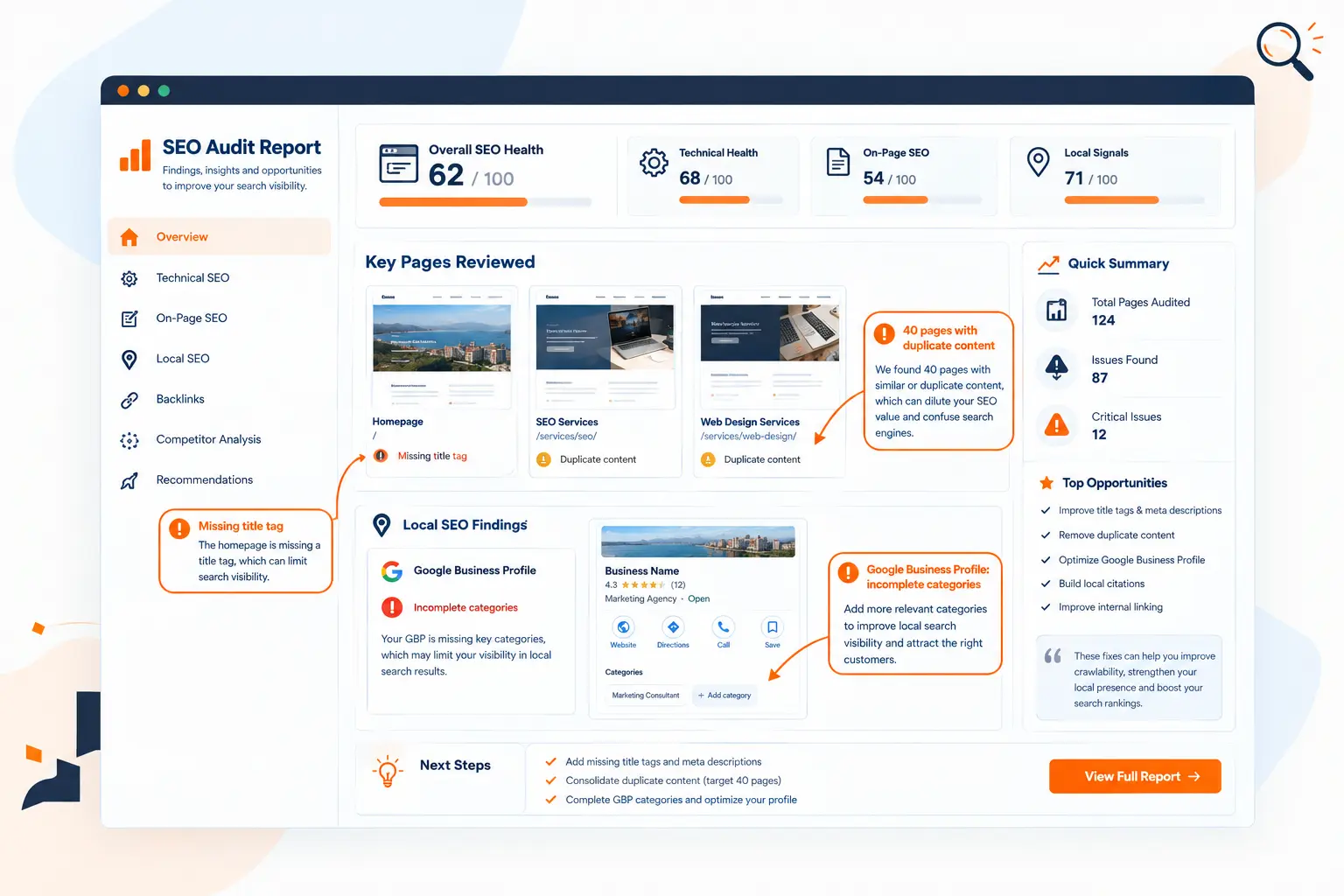
Why it matters: Any agency worth hiring should be able to look at your site for 20 minutes and tell you something specific — not “your SEO needs work,” but “your product pages are missing title tags,” or “you have 40 pages returning duplicate content because of your URL structure.”
A proper website audit (sometimes called an SEO audit) checks technical health (site speed, crawlability, mobile usability, broken links, indexing issues), on-page elements (titles, headers, meta descriptions, internal linking), content gaps against competitors, and local signals like your Google Business Profile completeness. If a salesperson can only speak in generalities — “we’ll do a deep dive once you sign” — that’s a sign they don’t actually audit sites before pitching them; they run a templated pitch deck instead.
What a strong answer sounds like: “Here’s what we found on your homepage, your top three service pages, and your Google Business Profile — and here’s roughly where the biggest opportunities are.” Specific. Screenshotted. Tied to your actual site.
2. How Do You Approach Keyword Research for a Market as Specific as Victoria, BC?
Why it matters: National keyword tools often show “0” or misleadingly low search volume for hyper-local terms, because the tool’s data is aggregated at a country or province level. An agency relying purely on default tool output — without cross-referencing Google Search Console data, Google Business Profile insights, and actual customer language — will chase the wrong terms or miss high-intent ones entirely.
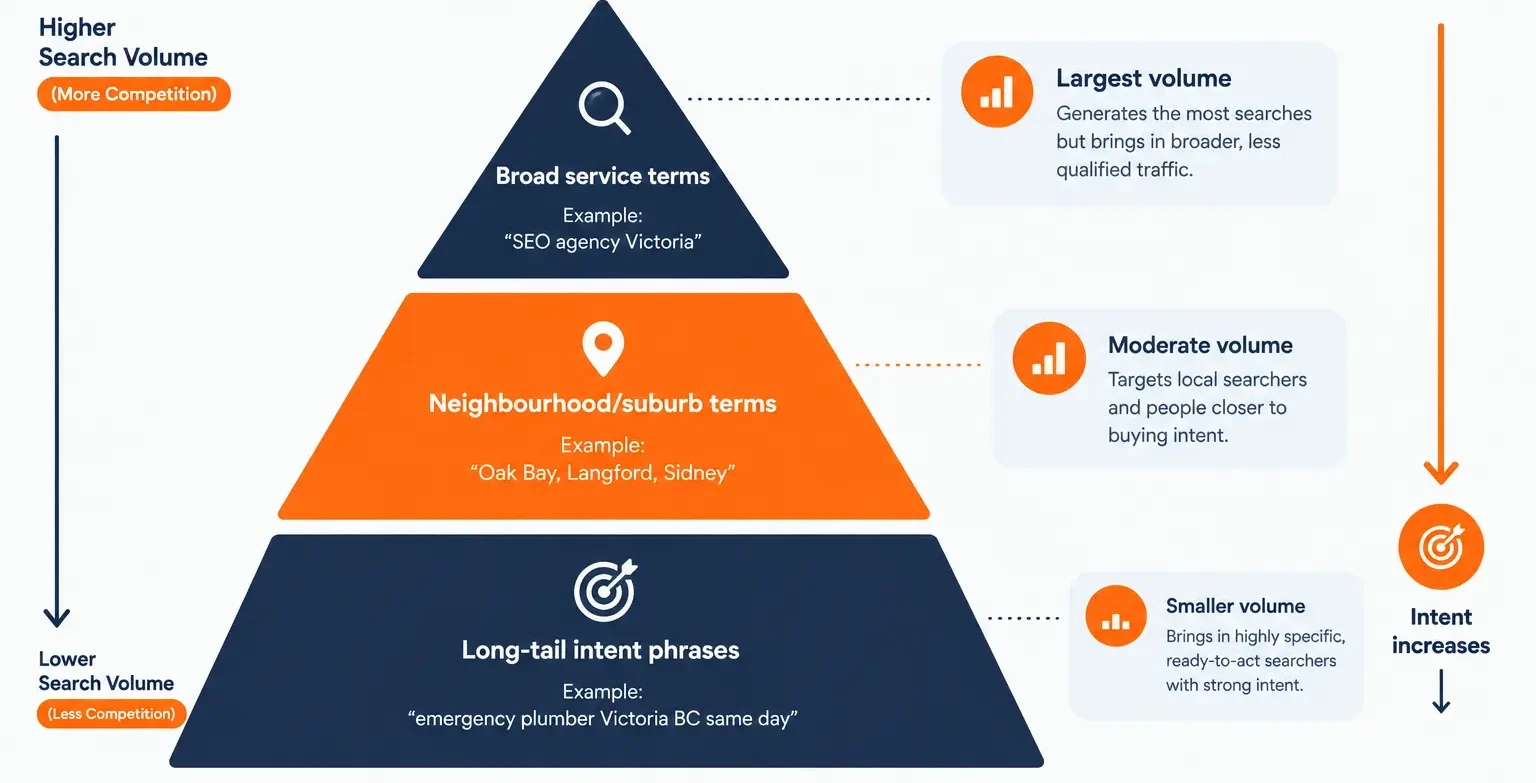
Good keyword research for a Vancouver Island business balances three layers: broad service terms (“SEO agency Victoria,” “best local seo company”), neighbourhood- and suburb-level terms (Saanich, Oak Bay, Langford, Sidney), and long-tail, intent-heavy phrases that map to how people actually type when they’re ready to buy or book (“emergency plumber Victoria BC same day,” not just “plumber”).
Ask specifically: “How would you research keywords for a business like mine that serves both downtown Victoria and the broader Westshore?” If the answer is generic, keep looking.
3. What Does Your On-Page and Technical SEO Process Actually Include?
Why it matters: “On-page optimization” and “technical SEO” get thrown around as one vague blob in a lot of sales pitches, but they’re two distinct disciplines, and skipping either one caps how high you can realistically rank.
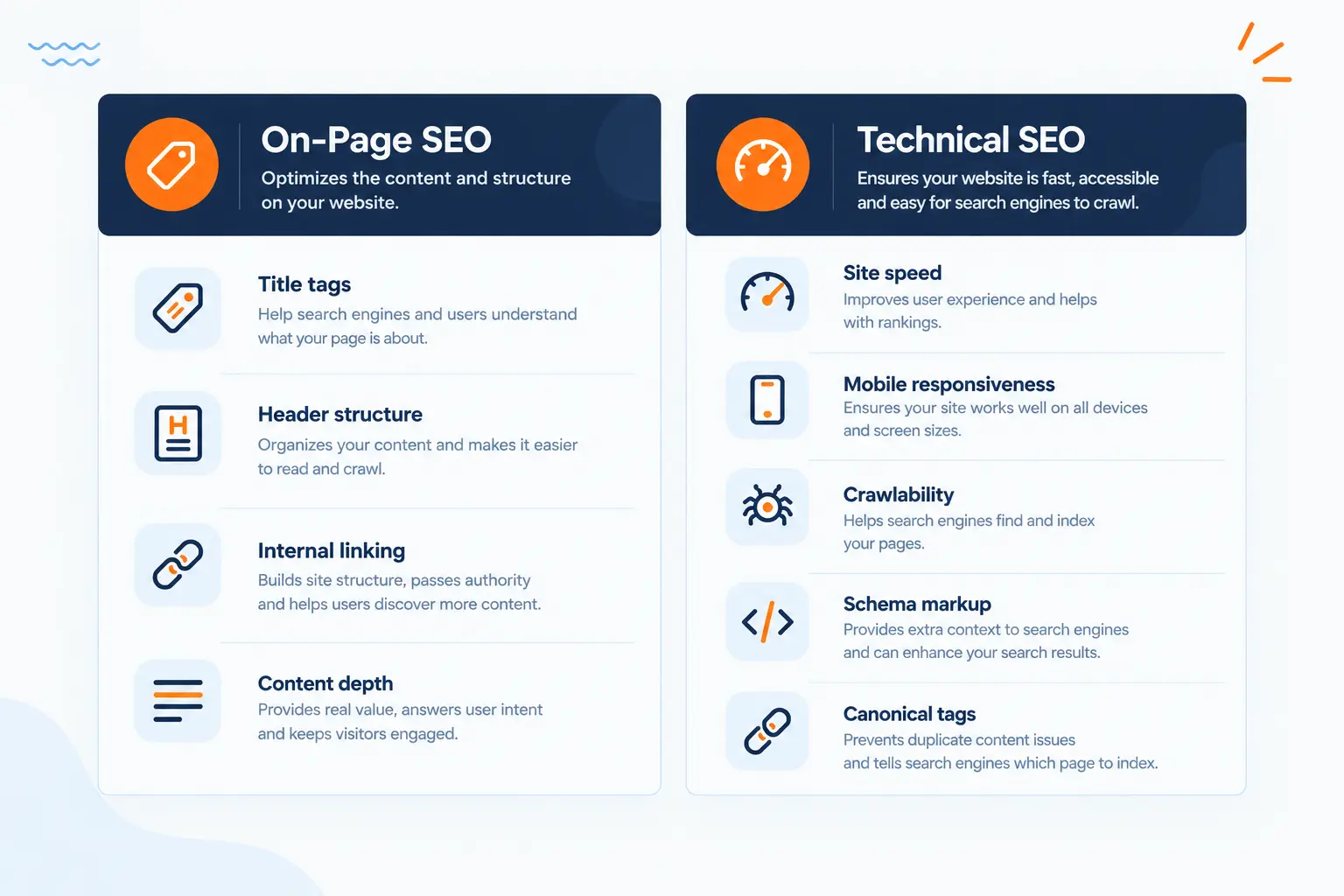
On-page optimization covers the content-facing side: title tags, header structure, internal linking, content depth, and making sure each page actually answers the question a searcher typed. Technical SEO covers the plumbing: site speed, mobile responsiveness, crawlability, structured data (schema markup), canonical tags, and making sure Google can actually find, load, and trust your pages in the first place. A site can have beautifully written content and still rank poorly because it loads slowly on mobile or has a crawl error blocking half its pages from Google’s index.
A useful follow-up: “If my site has a technical issue you can’t fix in-house — say, a hosting or platform limitation — how do you handle that?” A capable agency will have a clear answer, not a shrug.
4. How Will You Manage My Google Business Profile and Local Pack Rankings?
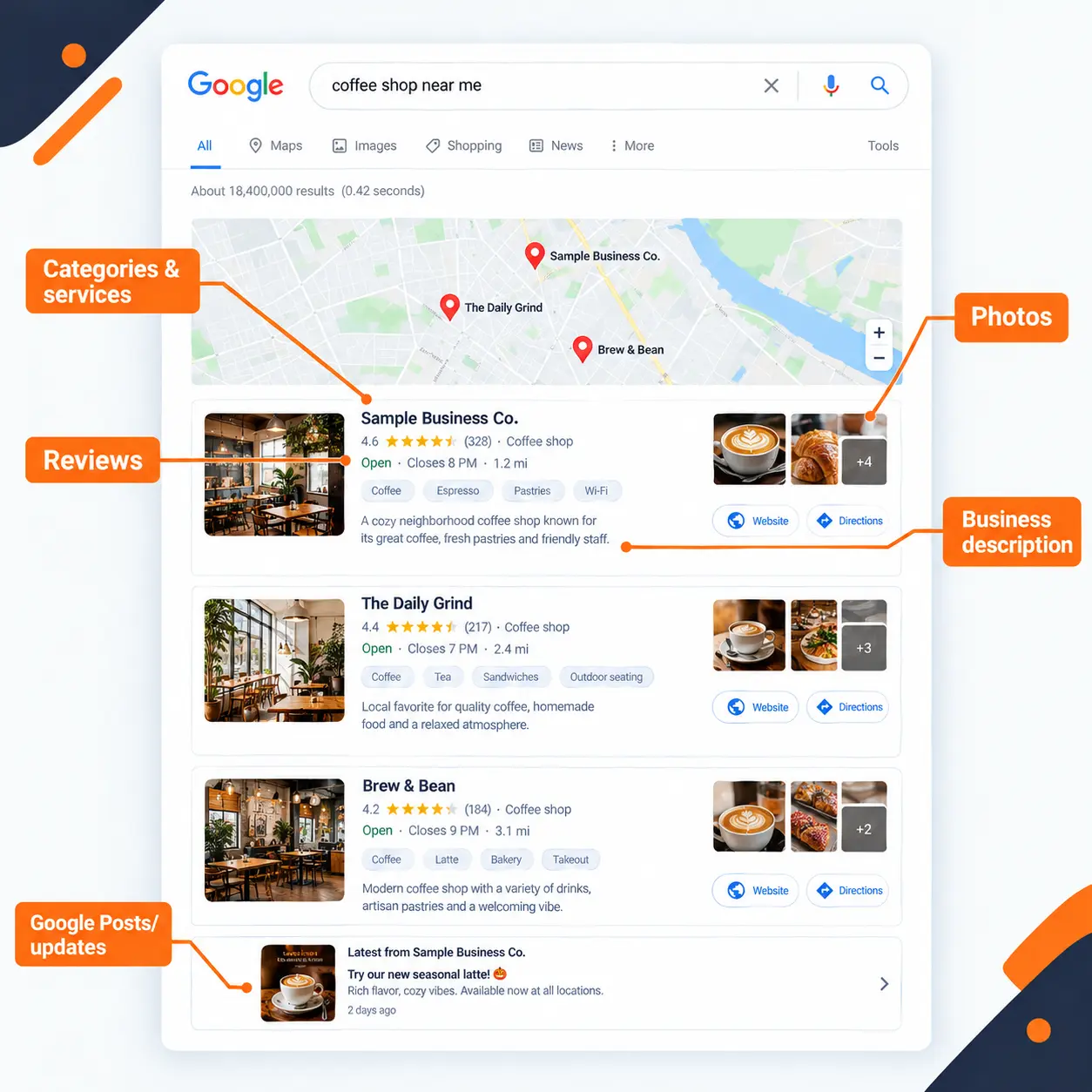
Why it matters: For most Victoria service businesses — trades, clinics, restaurants, salons, contractors — the Google Business Profile and the map-based local pack ranking (the three businesses shown with the map at the top of a local search) drive more leads than the traditional organic results below them. If your prospective agency treats your Business Profile as an afterthought they’ll “set up once and revisit later,” that’s a real gap.
A serious local SEO process includes: full Business Profile optimization (categories, services, photos, business description), a citation consistency check across directories (your name, address, and phone number need to match everywhere), a review-generation strategy, and regular Google Posts or updates. Ask how they’ll handle the seasonal swings mentioned earlier — a strategy built for a tourism-heavy Victoria business in July should look different than one built for the slower shoulder season.
You can verify a lot of this yourself, too — Google’s own Business Profile Help Center is a useful baseline for what a fully optimized profile should include, so you’re not relying entirely on the agency’s word for it.
5. What's Your Link-Building Process, and Can I See Real Examples?
Why it matters: Link building — getting other reputable websites to link back to yours — remains one of the strongest trust signals in both traditional rankings and AI-generated answers. It’s also the part of SEO most likely to be outsourced to low-quality, high-volume tactics that can quietly damage a site rather than help it.
Ask directly what kinds of links they build: local business directories and Chamber of Commerce listings, digital PR and local media mentions, guest content on genuinely relevant sites, or resource-based links earned through original data or research. Be wary of anyone promising a specific number of links per month with no mention of relevance or quality — link building isn’t a volume game, and a handful of strong, locally relevant links usually outperforms fifty low-quality ones.
Red flag phrasing to listen for: “We have a network of sites we place links on.” That’s often a euphemism for a private link network, which can get a site penalized rather than ranked.
6. Who Writes the Content, and How Do You Build an SEO Content Strategy?
Why it matters: A content strategy built purely around keyword density, with no regard for whether the content is actually useful, tends to underperform in 2026 — both in traditional rankings and in AI Overviews, which specifically favour content that reads like it was written by someone who understands the topic firsthand.
Ask who actually writes the content: an in-house team, a freelance pool, or an overseas content mill working from a brief with zero context on your business. Ask to see writing samples from a client in a comparable industry. A well-built SEO strategy ties content directly to a keyword and topic map — covering not just “SEO company Victoria BC” style commercial pages, but the informational questions your customers are actually asking before they’re ready to buy.
7. How Are You Adapting Your Strategy for AI Overviews and AI Search?
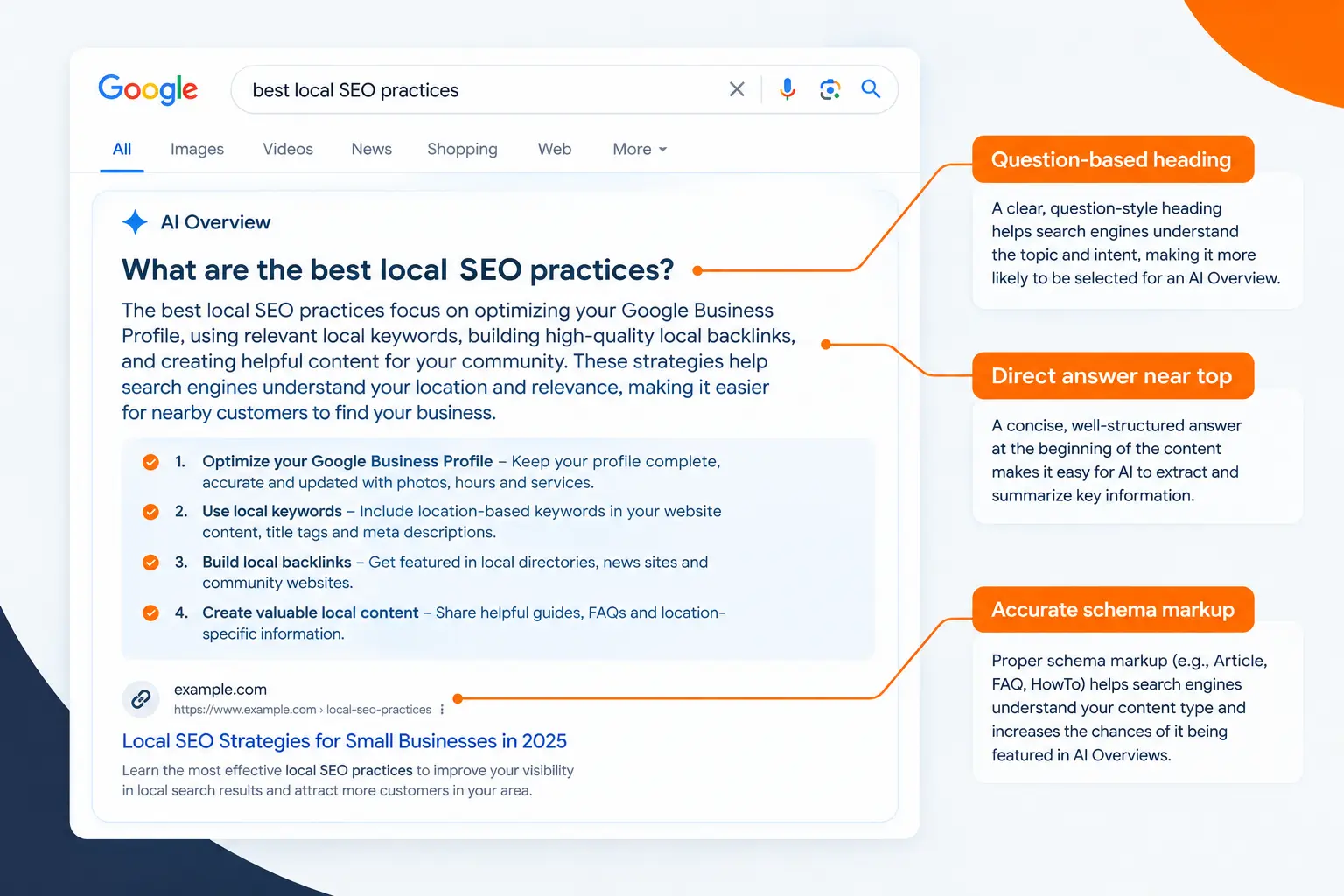
Why it matters: This is the question that separates an agency still running a 2021 playbook from one that’s actually current for 2026. Google’s own AI Overviews now appear across a large and growing share of searches, and platforms like ChatGPT, Perplexity, and Gemini have become genuine discovery channels for some buyers. If an agency’s answer to “how do you handle AI search” is a blank stare, that’s a meaningful gap.
Here’s the honest, slightly less hyped version of the answer, straight from Google itself: according to Google’s own guidance on AI features in Search, there are no secret extra requirements to appear in AI Overviews beyond strong fundamental SEO — clear, well-structured, genuinely helpful content that directly answers what someone is asking. The agencies worth hiring in 2026 aren’t selling you a mysterious new “AEO trick.” They’re doing excellent, answer-first content and technical SEO, structured so both people and AI systems can easily understand and extract it — things like clear question-based headings, direct answers near the top of a section, and accurate schema markup.
A good answer sounds like: “We structure content to directly answer specific questions, keep our technical SEO clean so AI crawlers can access and understand the page, and we track AI-referral traffic alongside traditional rankings.” That’s a real, current strategy — not a sales buzzword.
8. How Will You Report on Organic Traffic and Search Rankings — And Do I Own the Data?
Why it matters: Organic traffic and search rankings are the two most commonly reported metrics in SEO, and also the two most commonly used to paper over a lack of real business results. Rankings for an obscure keyword nobody searches, or a traffic spike from an irrelevant blog post, look good on a report and mean almost nothing to your bottom line.
Ask what gets reported and how often, and — just as important — ask whether you retain full access and ownership of your Google Analytics and Google Search Console accounts. Some lower-quality providers set these up under their own agency login, which makes it painful (or impossible) to leave cleanly and take your historical data with you. Your data should always live in accounts you control.
A strong reporting cadence ties every metric back to something you actually care about: leads, form fills, phone calls, or bookings — not just a rising line on a rankings chart.
9. What's Included in Your Pricing, and How Much Should I Actually Expect to Pay?
Why it matters: This is usually the first question business owners want to ask and the last one they actually get a straight answer to. Vague, all-inclusive-sounding pricing (“just $299/month for full SEO!”) is one of the most reliable warning signs in the entire industry — real SEO work is labour-intensive, and a price that low almost always means minimal, templated, or automated work.
Most of the hard data on seo pricing packages comes from larger U.S. and global agency surveys, since Canada-specific figures are harder to come by, but the general ranges translate reasonably well to the victoria bc seo market once you account for it being a smaller region than Vancouver or Toronto. As a rough, general guide for 2026:
investment
choice
scale
cost
engagement
If you’re weighing how much does seo cost against what it’s actually worth for a business your size, it’s worth reading a closer, honest breakdown of whether SEO is worth it for a small business in Victoria, BC before you commit to a number.
Whatever number you land on, ask for an itemized breakdown — content, technical work, link building, local SEO, and reporting — rather than one bundled figure. It’s the only way to compare quotes from different best local seo services providers on equal footing, and it’s the easiest way to spot a provider who’s quietly cutting corners on the labour-intensive parts (content and link building) to hit a lower headline price.
10. What Happens If I Don't See Results — And Can I Talk to Real Clients?
Why it matters: Anyone can promise growth in a sales call. What separates a genuinely accountable SEO agency in Victoria, BC from a risky one is what’s actually written down for when things don’t go to plan.
Be skeptical of vague, unconditional promises like “we’ll get you to #1” with no keyword named, no timeline attached, and no consequence if it doesn’t happen — that’s marketing language, not a commitment, and no ethical provider can control Google’s algorithm outright. But there’s a real difference between an empty promise and an accountable one. A trustworthy guarantee, where an agency offers one, should name the specific target keywords, attach a real timeframe, and spell out exactly what happens if they miss it — free continued work, a defined remedy, something concrete you could point to in writing.
Ask for client references you can actually contact, not just a testimonials page. Ask what industries they’ve worked in, and whether they’ve ever had a client’s traffic drop after a Google algorithm update — and if so, what they did about it. An agency with zero setbacks in its history has either been extremely lucky or isn’t being fully honest with you.
Red Flags to Watch For When Vetting a Victoria SEO Company
A few warning signs worth listening for across any of the conversations above:
| Green flag | Red flag |
|---|---|
| Names specific keywords and a realistic timeline | Promises "#1 rankings" with no keyword, no date, no remedy |
| Explains their audit findings with screenshots from your actual site | Speaks only in generalities about "SEO best practices" |
| You keep full ownership of Analytics and Search Console | Accounts are set up under the agency's own login |
| Transparent, itemized monthly pricing | A single bundled price with no breakdown |
| Can name real, contactable clients | Only shows anonymous "300% traffic increase" screenshots |
| Talks about link quality and relevance | Promises a fixed number of links per month, no context given |
| Has a clear answer for how they handle AI Overviews | Blank stare, or "we don't really do that yet" |
Your Free Pre-Hiring Checklist
You Hire an SEO Agency
The right SEO partner will be transparent, strategic and focused on your business goals. Use this checklist to ask the right questions and make a confident decision.
Better results.
Bring this into your next discovery call with any search engine optimization companies near me you’re considering:
- Have they audited my actual website, not just given a generic pitch?
- Can they explain their keyword research process for a market the size of Victoria/Vancouver Island?
- Do they clearly separate on-page optimization from technical SEO — and can they explain both?
- Do they have a specific plan for my Google Business Profile and local pack visibility?
- Can they describe their link-building approach without vague language like “our network”?
- Do I know exactly who writes my content, and can I see samples?
- Do they have a real, current answer for how they handle AI Overviews and AI search?
- Will I keep full ownership of my Analytics and Search Console data?
- Is the pricing itemized, with no single-figure “everything included” number?
- Is there something in writing about what happens if targets aren’t met?
If an agency clears most of this list without hesitation, you’ve likely found a legitimate partner. If they dodge more than two or three, keep interviewing.
Ready to Vet Your Next SEO Partner — Or Skip the Guesswork Entirely?
Going through these ten questions with two or three agencies will take a few hours, but it’s a few hours that can save you six wasted months and a chunk of your marketing budget. If you’d rather cut straight to a team that already answers all ten without hesitation, Maples Digital is a Victoria, BC-based agency built around exactly this kind of accountability — including a written commitment to a Top 3 Google ranking within 6 months, or continued work at no additional cost until you get there.
You can see the full breakdown of that process on our SEO services in Victoria, BC page, or skip straight to a conversation. Maples Digital offers a free, no-obligation SEO audit for Victoria and Vancouver Island businesses — the same kind of audit this guide recommends you ask for from anyone you’re considering.
Related Reading
Frequently Asked Questions
Most small businesses in Victoria can expect to pay somewhere between $750 and $3,000 per month for genuine, full-service SEO, with highly competitive industries or multi-location businesses running higher. One-time audits typically range from $500 to $2,500. Be cautious of anything advertised under roughly $300/month — that price point rarely covers real, ongoing work.
Most agencies will say “three to six months,” and that’s a reasonable starting range, though it depends heavily on your site’s starting condition and competition level. For a fuller, data-backed breakdown of realistic timelines, see how long it actually takes Google to rank a new website.
A local agency isn’t strictly required, but it does save ramp-up time — they already understand Vancouver Island’s municipalities, seasonal tourism patterns, and local competitive landscape. A remote or national agency can still do excellent work if they can show case studies from a comparable-sized city and take the time to genuinely learn your local market rather than applying a one-size-fits-all template.
SEO is the broader discipline of improving visibility in search results generally. AEO (answer engine optimization) specifically refers to optimizing content to be selected and cited by AI-generated answers, like Google’s AI Overviews, ChatGPT, or Perplexity. In practice, the two overlap heavily — clear, well-structured, genuinely helpful content tends to perform well in both.
No agency can control Google’s algorithm, so an absolute, unconditional guarantee of a specific ranking position should always be treated with caution. What a reputable agency can do is offer an accountable, defined commitment — naming specific keywords, a realistic timeframe, and a clear remedy if they don’t deliver — which is very different from a vague, no-strings promise made in a sales pitch.
Ask to see an SEO audit of your actual website before you sign anything. It’s the fastest way to tell whether you’re talking to a team that genuinely understands your site, or a salesperson running through a script.